
Global report on cost of hearing loss 2017 – WHO – World Health Organization
Millions of people worldwide continue to experience the impacts of unaddressed hearing loss and lack access to essential ear and hearing care services. This report analyses the global cost of hearing loss, outlining its key components and, where possible, assigning monetary values to direct health system costs and broader societal impacts.
Current state of hearing loss 2021 – WHO – World Health Organization
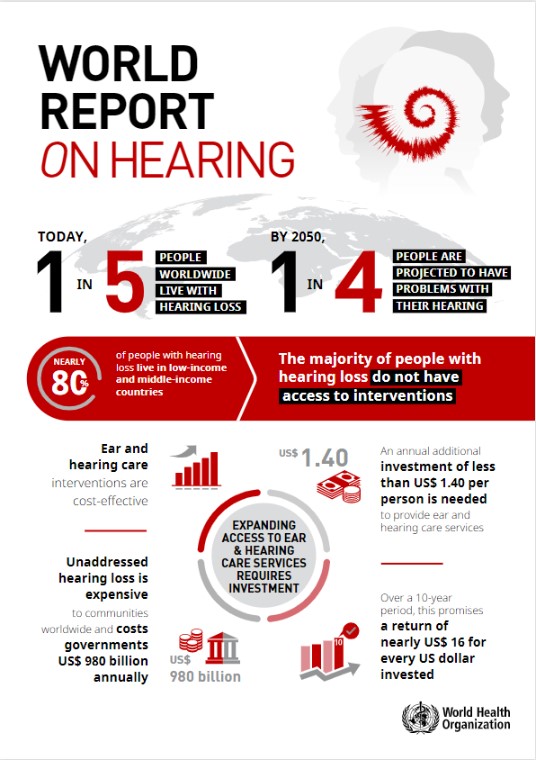
The report provides a framework to guide future action in ear and hearing care. It outlines a package of evidence-based interventions that Member States can adopt and describes strategies for integrating these approaches into national health systems. The goal is to promote equitable access to hearing care for all people who need it, without financial […]
Clinical practice guidelines for age-related hearing loss
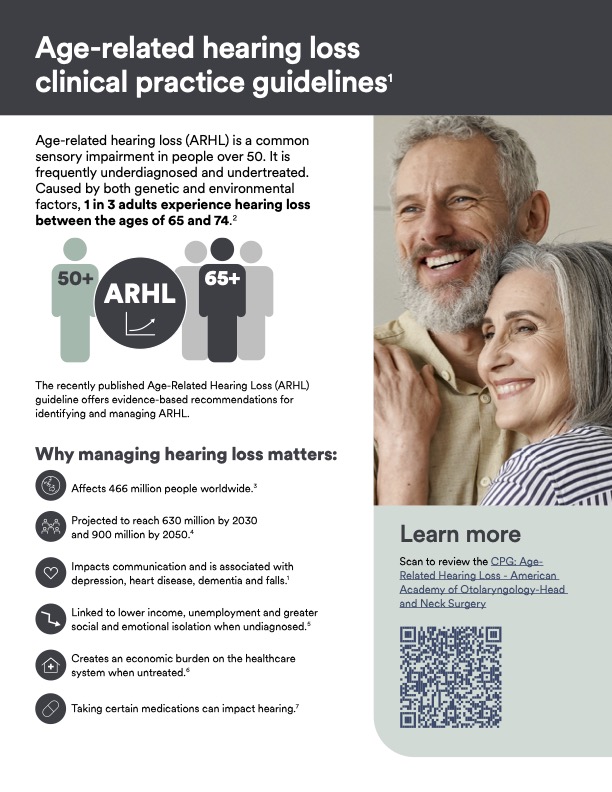
Age-related hearing loss is among the most common sensory conditions in adults over the age of 50. To support earlier identification and effective management, the American Academy of Otolaryngology has developed evidence-based clinical practice guidelines for age-related hearing loss. Key takeaways: Refer adults for hearing screening to support early identification of hearing loss Refer adults […]
International consensus for treating adults with severe-profound hearing loss
The International Consensus Statement outlines 20 global recommendations to support adults with severe to profound hearing loss in achieving better hearing outcomes and quality of life. The guidance was developed collaboratively by clinical experts and patient representatives from multiple countries. Key statements: Pure tone audiometry is the most effective screening method to identify cochlear implant […]
Referral quick guide
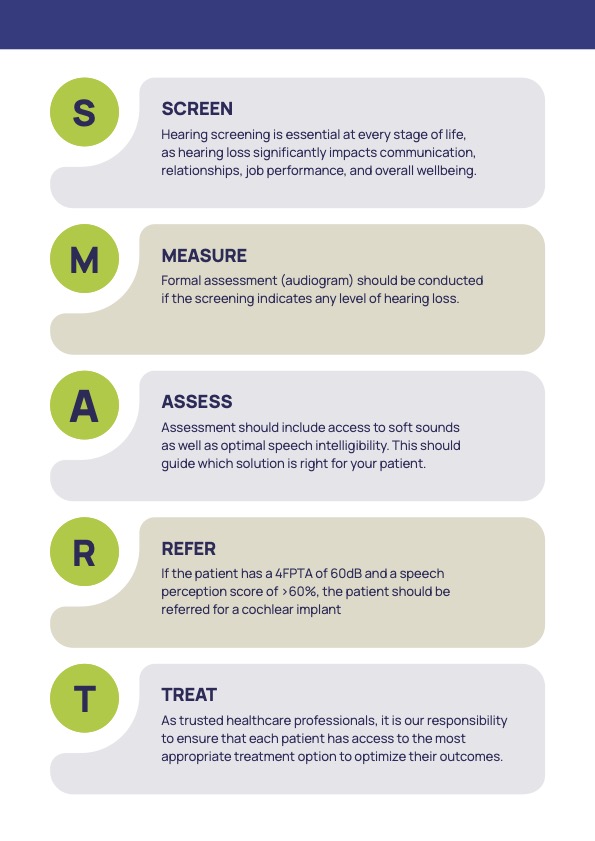
This document provides a list of questions to ask a patient to assess if a cochlear implant referral will be relevant. It also provides a quick guide of relevant steps to consider when referring a patient for a cochlear implant evaluation.
Hearing loss levels
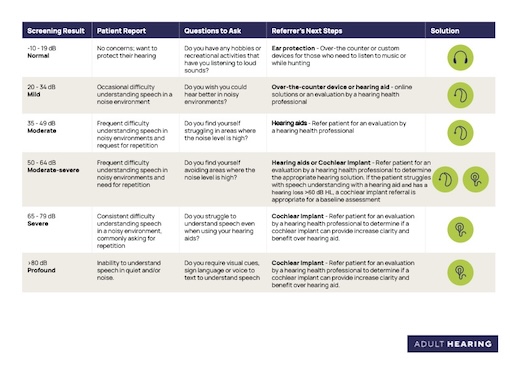
This document provides an overview of what patients often report depending on hearing loss level and what questions are relevant to ask to find out more about their situation. It also provides relevant next steps for referring professionals and guides on what hearing intervention that may be relevant.
Evidence-based referral criteria for cochlear implants in adults
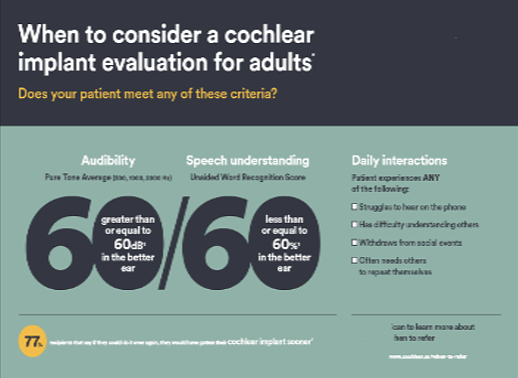
The 60/60 guideline is a simple screening rule to help identify adults who may benefit from referral for a cochlear implant evaluation. In a study of 529 adults, the guideline identified the majority of individuals who were later confirmed as cochlear implant candidates through comprehensive assessment. Consider referral for a cochlear implant evaluation when both […]
Global treatment guidelines for cochlear implants in adults
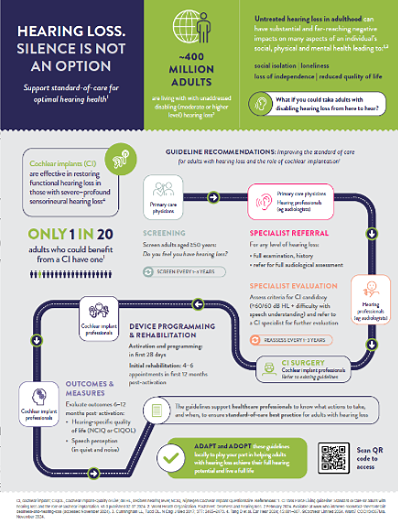
The Cochlear Implant Living Guidelines outline best practices across the hearing care pathway, from early identification of hearing loss and referral through to long-term support after cochlear implantation. The guidelines were developed by an international task force that included multi-disciplinary experts across hearing research, hearing health care, otolaryngology, public policy as well as those with […]
Visualization of cochlear implant benefit – Referral support tool
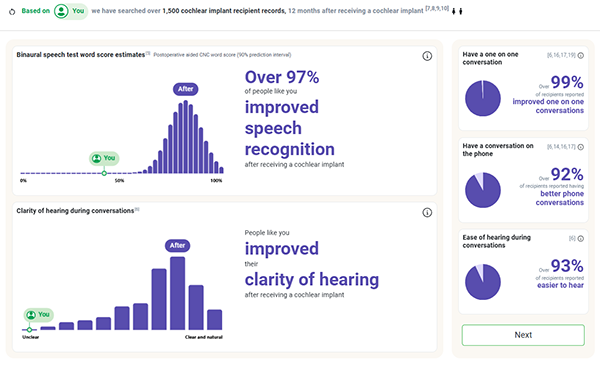
This referral support tool helps clinicians explore how a patient’s hearing may change following cochlear implantation by drawing on patient-specific audiological information and responses to structured questions. The tool applies published clinical evidence to generate illustrative ranges of expected outcomes that can support counselling and referral conversations. Individual results will vary, and the outputs are […]
Quick cochlear implant counseling guide for referring providers
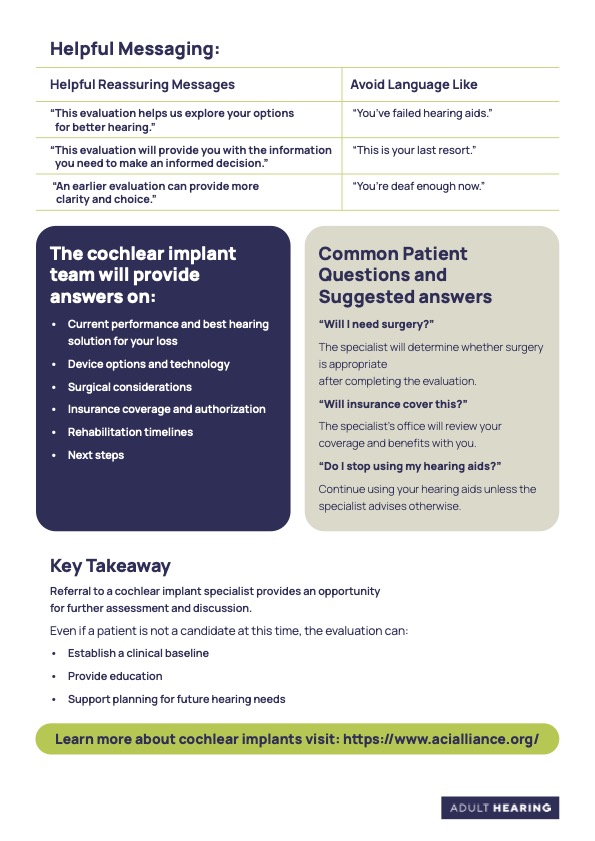
This document provides an overview of why and when a referral should be made, how to discuss it with the patient and which questions the cochlear implant team will answer.